
September 17, 2026
Video Commercials: Creative Strategies for 2026
Master video commercials in 2026. Learn production strategies, platform optimization, creative frameworks, and AI-powered workflows for brands.
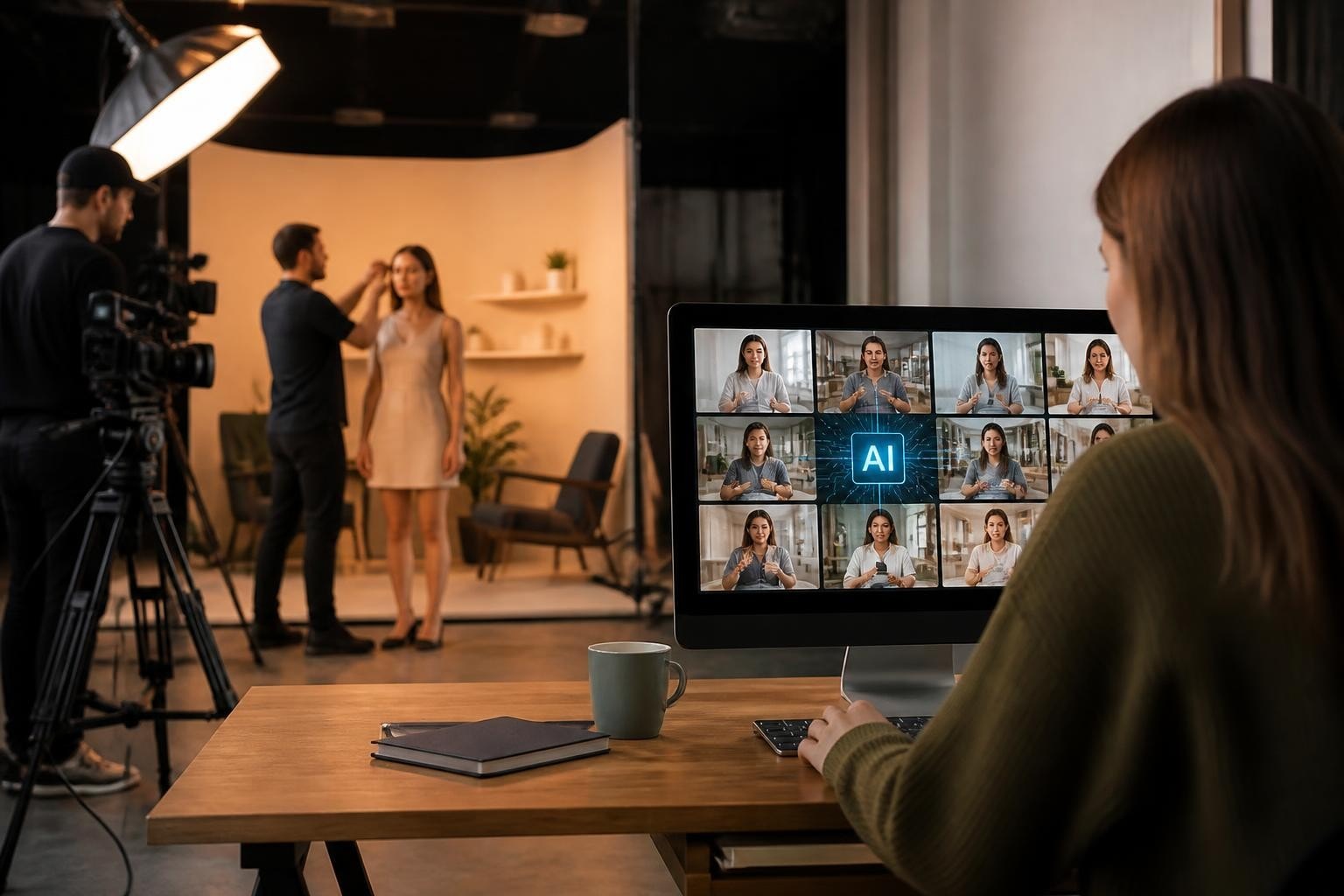
Video commercials remain the most powerful tool in a marketer's arsenal, but the landscape has shifted dramatically. Traditional 30-second spots designed for linear television now compete with short-form user-generated content that captures attention in milliseconds on TikTok and Instagram Reels. Today's brands must navigate multiple platforms, each with unique creative requirements, while maintaining consistency and driving measurable performance. The challenge isn't just creating video content-it's producing scroll-stopping commercials at the speed and scale that modern digital advertising demands.
The Current State of Video Commercial Production
The video advertising industry continues its explosive growth trajectory. According to IAB's 2024 Digital Video Ad Spend & Strategy report, digital video ad spend is growing nearly 80% faster than media overall, reflecting the format's dominance in capturing consumer attention. This surge isn't limited to one platform or format-it spans social video, connected TV, and emerging channels.
Modern video commercials must address several critical factors:
- Platform-specific creative requirements and aspect ratios
- Decreasing attention spans (average 2.7 seconds on social feeds)
- Rising production costs for traditional shoots
- Demand for continuous testing and iteration
- Need for authentic, user-generated aesthetics
The shift from broadcast to digital has fundamentally altered how brands approach commercial creation. Where a single 30-second spot might have served a campaign for months, today's advertisers need dozens of variations tested weekly to optimize performance.
Platform Diversification Challenges
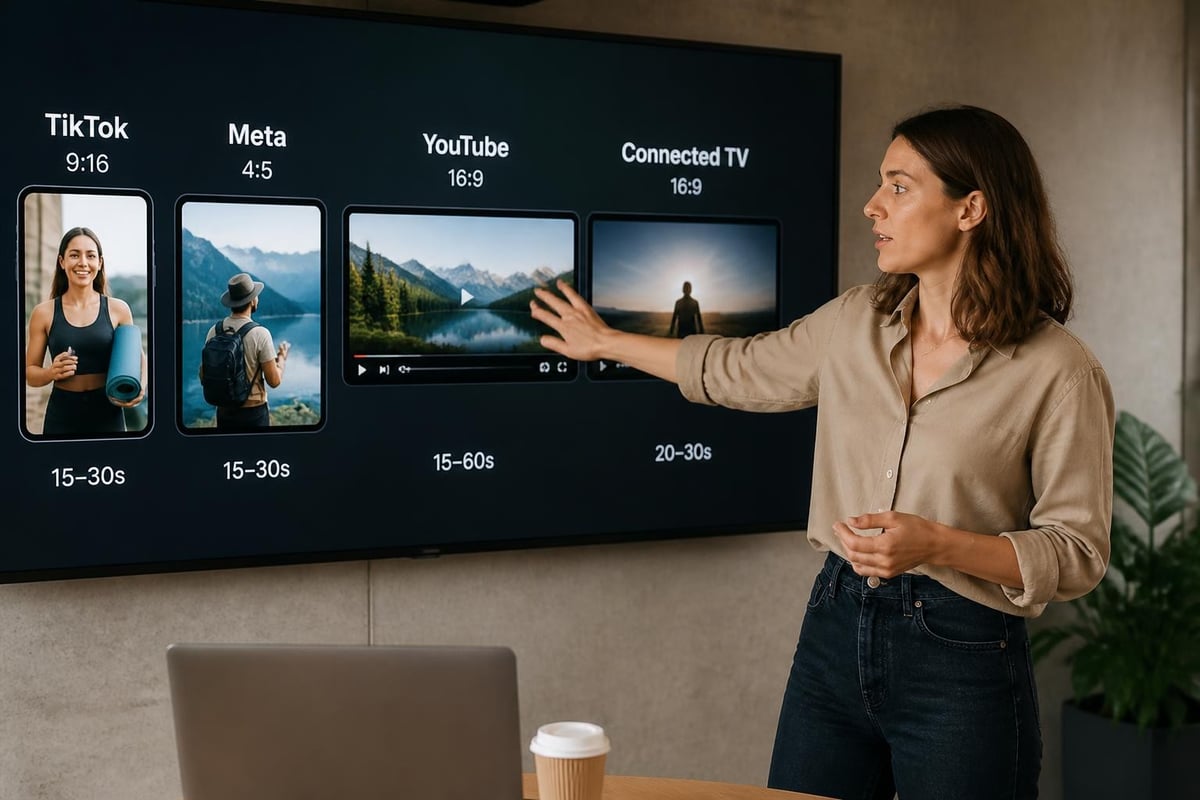
Each major platform requires distinct creative approaches. TikTok favors raw, authentic content that blends seamlessly into user feeds. Meta platforms reward quick hooks and clear value propositions in the first three seconds. YouTube supports longer narratives but demands strong opening frames to prevent skips.
This fragmentation creates production bottlenecks. Traditional agencies struggle to deliver the volume needed for proper testing across channels, while maintaining quality and brand consistency.
Creative Frameworks That Drive Performance
Successful video commercials in 2026 follow proven structural frameworks that maximize engagement and conversion. Understanding these patterns helps creators and marketers build effective ads systematically rather than relying on creative guesswork.
The Hook-Story-CTA Formula
The most effective short-form video commercials follow a three-part structure:
- Hook (0-3 seconds): Pattern interruption that stops scrolling
- Story (3-12 seconds): Problem-solution narrative or value demonstration
- CTA (12-15 seconds): Clear next step with urgency or incentive
This framework works because it aligns with how users consume content on social platforms. What makes a UGC hook work depends heavily on understanding audience pain points and presenting relatable scenarios within those first critical seconds.
User-Generated Content Aesthetics
Traditional commercial polish actually hurts performance on social platforms. Audiences have developed sophisticated filters for "ad-like" content and scroll past anything that feels overly produced.
High-performing UGC-style video commercials share these characteristics:
- Handheld, authentic camera work (no tripods or stabilizers)
- Direct-to-camera testimonials from real users or creators
- Natural lighting and everyday settings
- Conversational language instead of scripted copy
- Visible product demonstrations in context
The challenge is maintaining brand safety and message consistency while preserving this authentic feel. Many brands struggle to scale UGC production because they depend on recruiting, briefing, and managing individual creators-a process that's slow and unpredictable.
| Element | Traditional Commercial | UGC-Style Commercial |
|---|---|---|
| Production quality | High polish, professional crew | Authentic, creator-led |
| Setting | Studio or curated location | Real environment |
| Talent | Actors with scripts | Creators or customers |
| Editing | Multi-cam, effects-heavy | Single-take or minimal cuts |
| Performance (social) | Lower engagement, higher CPM | Higher engagement, lower CPM |
Optimizing Video Commercials for Each Major Platform
Platform-specific optimization separates high-performing campaigns from wasted ad spend. Each channel has unique technical requirements, audience expectations, and algorithmic preferences that influence creative strategy.
TikTok Commercial Best Practices
TikTok's algorithm rewards content that keeps users on the platform. Video commercials must blend into organic content patterns while delivering clear commercial messages.
Technical specifications:
- 9:16 vertical format (1080x1920)
- 15-60 second duration (optimal: 21-34 seconds)
- Captions required (85% watch without sound)
- Hook within first 1.5 seconds
The platform favors trend participation and native features. Commercials that incorporate popular sounds, effects, or formats outperform generic video ads. According to Think with Google's video insights, creative testing should be continuous, with new variants introduced weekly based on performance data.
Meta Platform Requirements
Instagram Reels and Facebook video commercials share similar technical specs but serve slightly different audiences. Instagram skews younger and more visual, while Facebook reaches broader demographics with longer attention spans.
Both platforms prioritize watch time and meaningful interactions. Video commercials that generate saves, shares, and comments receive algorithmic boosts that reduce cost per impression.
- Reels: 9:16 vertical, 15-90 seconds, sound-on assumed
- Feed: Square (1:1) or vertical (4:5), 15-60 seconds
- Stories: 9:16 vertical, 15 seconds max, full-screen immersive
YouTube and Connected TV Strategies
YouTube supports longer narrative arcs, allowing for more complex storytelling than social platforms. However, the skip button at 5 seconds demands strong openings.
Connected TV (CTV) advertising brings video commercials back to the living room but with digital targeting and measurement. Nielsen's audience insights show viewing fragmentation across streaming services, making CTV a critical channel for reaching cord-cutters.
Scaling Production Without Sacrificing Quality
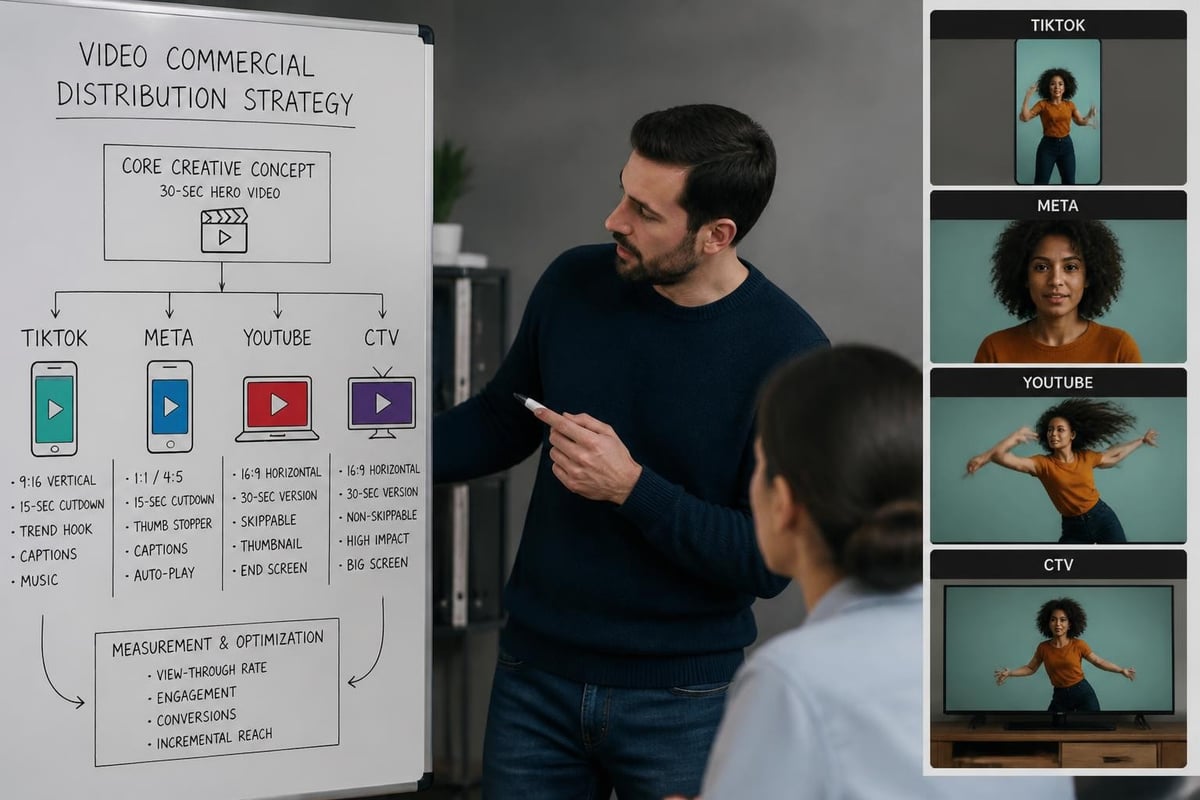
The biggest bottleneck in modern video commercial strategy is production capacity. Brands need 20-50 creative variants monthly to test effectively across platforms, but traditional production methods can't deliver that volume cost-effectively.
Traditional Production Constraints
A standard video commercial shoot involves extensive coordination:
- Concept development and scripting (1-2 weeks)
- Talent sourcing and scheduling (1-2 weeks)
- Location scouting and permitting (1 week)
- Shoot day logistics (1-3 days)
- Post-production and revisions (1-2 weeks)
This timeline works for hero campaigns but fails for the continuous testing modern platforms demand. The cost per finished commercial typically ranges from $5,000 to $50,000 depending on production quality and talent fees.
AI-Powered Commercial Generation
Artificial intelligence has transformed video commercial production by removing the most significant bottleneck: actual filming. AI video generation platforms can now produce UGC-style commercials that match the authentic aesthetic that performs best on social platforms.
The workflow shifts from coordination-heavy production to brief-driven generation:
- Input brand guidelines and product information
- Define target audience and platform specifications
- Generate multiple creative variants with different hooks
- Review, refine, and deploy winning concepts
- Iterate based on performance data
This approach dramatically reduces both cost and timeline. Brands can test 10x more creative concepts with the same budget, accelerating learning and optimization. For performance marketers managing direct-to-consumer brands, this scalability is transformative. VidBud's AI-powered platform enables creators and marketers to turn creative briefs into platform-ready UGC ads without managing traditional production workflows, making it possible to maintain constant creative testing across TikTok and Meta.

Measurement and Attribution Strategies
Creating effective video commercials is only half the challenge. Understanding what drives performance requires robust measurement frameworks that connect creative elements to business outcomes.
Key Performance Indicators by Objective
Different campaign objectives demand different success metrics:
| Objective | Primary KPIs | Secondary KPIs |
|---|---|---|
| Awareness | Impressions, Reach, View-through rate | Brand lift, Share rate |
| Consideration | Click-through rate, Engagement rate | Video completion rate, Save rate |
| Conversion | ROAS, CPA, CVR | Add-to-cart rate, Landing page time |
The relationship between creative elements and performance isn't always linear. Research on measuring video advertising impact demonstrates that short-term exposure effects can compound over time, making attribution complex.
Creative Testing Frameworks
Systematic testing reveals which creative elements drive performance. The most effective approach isolates variables:
Hook testing: Create identical commercials with different opening 3 seconds to identify which patterns stop scrolling most effectively.
Narrative testing: Test problem-first versus solution-first story structures to understand what resonates with your specific audience.
CTA testing: Experiment with different calls-to-action, urgency levels, and incentive presentations to optimize conversion.
According to WARC's research on video advertising effectiveness, attention metrics provide better predictive value than traditional viewability standards. Video commercials that maintain active attention for 6+ seconds drive significantly higher brand recall and purchase intent.

Technical Standards and Ad Serving
Behind every video commercial runs technical infrastructure that determines where and how it appears. Understanding these standards helps marketers ensure proper delivery and tracking across platforms.
VAST Protocol Compliance
The IAB Tech Lab's VAST specification (Video Ad Serving Template) is the accepted standard for video ad serving. VAST 4.x includes verification, viewability measurement, and support for various ad formats including linear, non-linear, and companion ads.
For connected TV specifically, the CTV addendum addresses unique requirements like app-ads.txt authentication and server-guided ad insertion. Ensuring your video commercials comply with VAST standards prevents delivery issues and enables accurate measurement.
File Specifications and Encoding
Technical quality directly impacts both approval rates and performance. Platform requirements vary, but general best practices include:
- Resolution: Minimum 1080p for social, 4K for CTV preferred
- Codec: H.264 or H.265 for maximum compatibility
- Bitrate: 8-12 Mbps for 1080p maintains quality while ensuring smooth playback
- Audio: AAC codec, stereo, normalized to -14 LUFS for consistency
- File size: Under 1GB for most platforms, smaller for mobile-first channels
Poor encoding creates buffering, pixelation, or rejection by platform review systems. Investing in proper technical QA prevents wasted spend on commercials that don't deliver optimal viewing experiences.
Budget Allocation and Media Planning
Strategic budget distribution across video commercial production and media buying determines overall campaign efficiency. The traditional 80/20 split (80% media, 20% creative) no longer reflects the importance of creative quality in driving performance.
Production vs. Media Investment
HubSpot's video marketing statistics show that creative accounts for 47% of campaign performance variance-meaning the commercial itself matters as much as where you run it. This suggests reallocating budgets:
Traditional split:
- 20% creative production
- 80% media buying
Optimized split:
- 35-40% creative production and testing
- 60-65% media buying
This reallocation enables constant creative refresh, which prevents ad fatigue and maintains performance. Video commercials lose effectiveness after 7-14 days on most platforms as audiences develop "banner blindness" to repeated creative.
Platform Budget Distribution
Where you allocate media spend depends on audience behavior and business objectives. Nielsen's Total Audience research tracks viewing shifts from linear TV toward streaming and social video, informing smarter distribution.
For direct-response campaigns targeting younger audiences, social platforms typically deliver stronger immediate ROAS. For brand-building with broader demographics, connected TV provides premium environments with less ad clutter.
Emerging Trends Shaping Video Commercial Strategy
The video commercial landscape continues evolving rapidly. Understanding emerging trends helps brands stay ahead of platform changes and audience preferences.
Interactive and Shoppable Video
Platforms increasingly enable direct purchasing within video commercials. TikTok Shop integration, Instagram product tags, and YouTube Shopping create seamless paths from discovery to purchase without leaving the platform.
These features work best with demonstration-focused commercials that showcase products in use. The key is balancing entertainment value with clear product visibility-too sales-heavy and users skip, too subtle and purchase intent doesn't convert.
AI Presenters and Synthetic Media
Virtual presenters and AI-generated humans now appear in video commercials across industries. When creating video with AI, brands must balance the efficiency gains against audience preferences for authentic human connection.
The most successful approach uses AI for scale while maintaining human oversight for brand alignment and quality control. Synthetic media works particularly well for product explanations, how-to content, and scenarios where traditional filming would be cost-prohibitive.
First-Party Data Integration
Privacy changes and cookie deprecation push video commercial targeting toward first-party data strategies. Brands building owned audiences through email lists, app users, and website visitors gain significant advantages in precise targeting and measurement.
This shift rewards brands that create valuable content ecosystems around their video commercials-turning ads into entry points for ongoing relationships rather than one-time impressions.
Building Sustainable Creative Systems
Long-term success with video commercials requires systematic approaches rather than one-off campaign thinking. The most effective brands build creative systems that produce consistently strong commercials at scale.
Creative Brief Development
Strong briefs drive strong commercials. Effective briefs should include:
- Target audience: Specific demographics, psychographics, and pain points
- Core message: Single clear value proposition (not multiple selling points)
- Proof points: Credible support for claims (stats, testimonials, demos)
- Brand guidelines: Visual identity, tone, approved language
- Success metrics: Specific KPIs that define performance
The connection between ad research and ad production ensures creative decisions are grounded in audience insights rather than internal assumptions. Research informs which pain points to address, which language patterns resonate, and which creative styles align with platform norms.
Iteration and Learning Cycles
The fastest-learning brands treat every video commercial as a test. Even "winning" ads get iterated with small variations to understand what specifically drives performance.
Weekly optimization cycle:
- Monday: Review previous week's performance data
- Tuesday: Generate new creative variants based on learnings
- Wednesday: Launch new tests alongside scaling winners
- Thursday-Friday: Monitor early performance indicators
- Weekend: Automated delivery continues while analyzing trends
This rhythm creates continuous improvement rather than static campaigns that decay over time.
Team Structure and Workflows
Organizations structured around agile creative production outperform those using traditional campaign models. Key roles include:
- Creative strategist: Translates audience research into creative direction
- Content producer: Executes or coordinates video production
- Performance analyst: Connects creative elements to outcomes
- Platform specialist: Ensures technical compliance and optimization
Cross-functional collaboration between these roles accelerates learning cycles. Weekly creative reviews that include both strategists and analysts ensure insights flow bidirectionally between creative and performance.
Video commercials continue evolving toward more authentic, platform-specific creative delivered at unprecedented scale and speed. Success requires balancing production quality with testing velocity, brand consistency with platform adaptation, and creative intuition with data-driven optimization. VidBud empowers brands and creators to meet these demands by transforming creative briefs into scroll-stopping UGC ads through AI-powered workflows-delivering the volume and variety modern platforms require without the bottlenecks of traditional production. Whether you're scaling an existing campaign or launching new creative strategies, the future belongs to teams that can iterate faster while maintaining authentic connections with their audiences.