
September 18, 2026
AI Creates Videos: The Complete 2026 Guide
Discover how AI creates videos for modern brands and creators. From UGC ads to enterprise content, learn platforms, workflows, and best practices.
The landscape of video production has fundamentally shifted in 2026. What once required cameras, actors, locations, and extensive post-production now happens through AI platforms that generate complete videos from text descriptions and creative briefs. The technology has matured beyond experimental novelty into a production-ready tool that brands, creators, and marketers deploy daily. Understanding how ai creates videos and where this technology fits into your content strategy has become essential for anyone working in digital advertising and content creation.
How AI Video Generation Technology Works
Modern AI video generation systems build on several interconnected technologies that work together to produce coherent, compelling video content. At the foundation lies diffusion models, which generate video frames by learning to reverse a noise-adding process, and transformer architectures that understand context across time and space within video sequences.
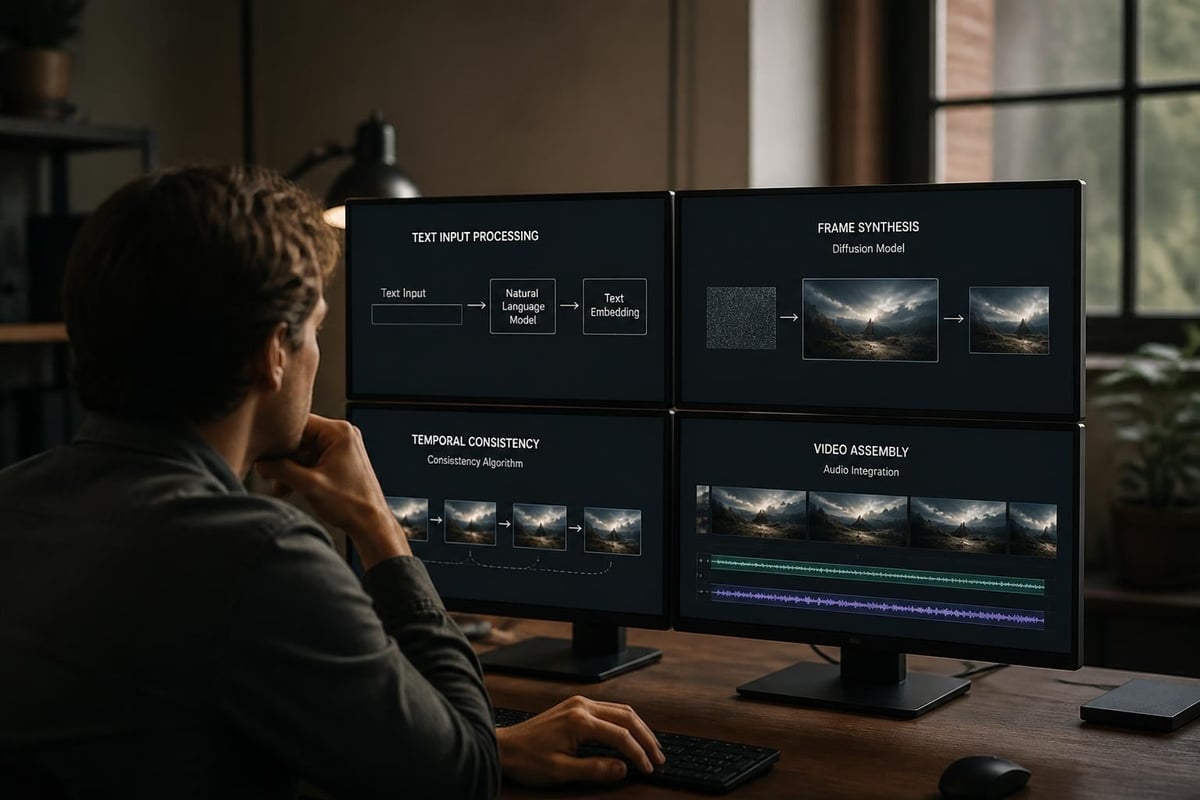
The process begins when you input a text prompt or creative brief. Natural language processing models parse your description, identifying objects, actions, scenes, and stylistic elements. This semantic understanding then guides the generation pipeline through multiple stages:
- Frame synthesis: The AI generates individual video frames based on learned patterns from millions of training videos
- Temporal consistency: Algorithms ensure objects and scenes remain coherent across consecutive frames
- Motion modeling: The system predicts and creates realistic movement, transitions, and camera angles
- Audio integration: Voice synthesis, music generation, and sound effects align with visual elements
The comprehensive technical architecture behind these systems continues to evolve, with researchers addressing challenges around long-form coherence, fine-grained control, and computational efficiency.
Training Data and Model Development
Behind every AI video generator sits massive datasets of video content paired with descriptive metadata. Training these models requires petabytes of video footage spanning diverse subjects, styles, and contexts. The models learn patterns of motion, object relationships, scene composition, and visual storytelling conventions.
Model developers face significant challenges around dataset curation, computational resources, and quality control. A survey of text-to-video approaches reveals the breadth of techniques teams employ to improve output quality, from multi-stage refinement to specialized fine-tuning on specific content types.
| Model Type | Primary Strength | Typical Use Case |
|---|---|---|
| Diffusion-based | High visual quality, realistic textures | Product shots, lifestyle content |
| GAN-based | Fast generation, lower compute cost | Social media clips, quick iterations |
| Transformer-based | Strong contextual understanding | Narrative content, complex scenes |
Applications Across Industries and Use Cases
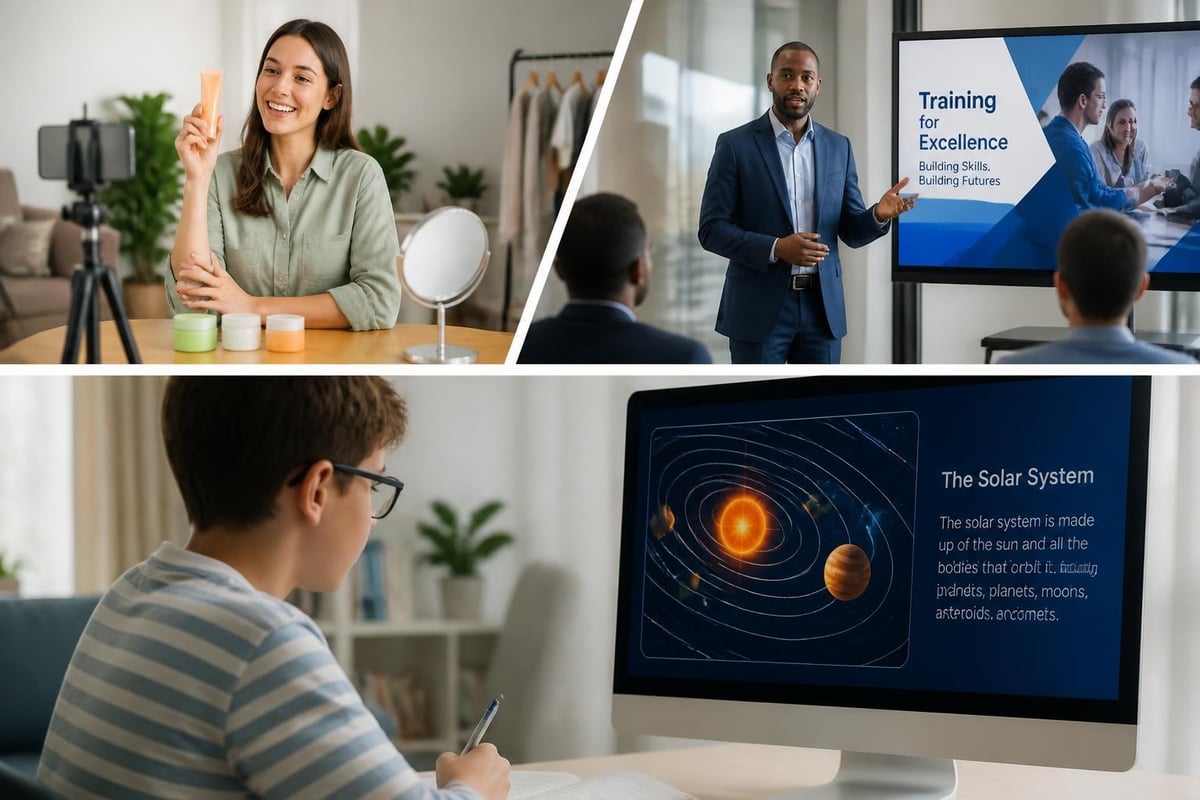
The technology proves valuable across an expanding range of applications, each leveraging different aspects of AI video generation capabilities. Marketing and advertising teams have rapidly adopted these tools to address persistent production bottlenecks.
Performance Marketing and UGC Ads
Digital advertisers face constant pressure to produce fresh creative at volume. Traditional UGC production requires recruiting creators, coordinating shoots, managing revisions, and dealing with rights. When ai creates videos that replicate UGC aesthetics, brands can test dozens of concepts weekly rather than monthly.
Performance marketers use AI-generated videos to:
- Launch rapid creative tests across audience segments
- Generate platform-specific variations (vertical for TikTok, square for Instagram)
- Iterate on winning concepts without reshoots
- Maintain consistent output during seasonal peaks
The shift toward AI-powered ad creative has changed how teams think about creative strategy, moving from "batch and blast" campaigns to continuous testing and optimization cycles.
Enterprise Content and Internal Communications
Corporations use AI video generation for training modules, product demonstrations, and employee communications. A single product brief can spawn multiple explainer videos tailored for different departments or global regions, each with appropriate messaging and localization.
IT and HR teams particularly benefit from scalable video production. Instead of scheduling studio time for routine policy updates or training refreshers, they generate clear, consistent videos on demand. The technology handles the visual production while subject matter experts focus on message accuracy and compliance.
Educational Content and E-Learning
Online education platforms leverage AI-generated video to visualize complex concepts, create engaging lecture content, and produce supplementary materials. Instructors describe scenarios, historical events, or scientific processes through text, and the AI renders them visually.
This application addresses a longstanding challenge in digital education: the production cost of quality video content often limits course offerings or forces reliance on dated materials. When ai creates videos from course outlines and scripts, educators can refresh content regularly and expand course catalogs without proportional budget increases.
Production Workflow and Creative Process
Implementing AI video generation requires rethinking traditional production workflows. The tools shift bottlenecks from filming logistics to creative direction and prompt engineering. Teams that succeed with this technology develop new skills around briefing AI systems effectively.
From Brief to Video: The Modern Workflow
- Market research and creative strategy: Analyze competitor ads, audience insights, and performance data to identify winning concepts
- Prompt development: Translate strategic direction into detailed text descriptions that guide the AI
- Generation and iteration: Produce initial videos, evaluate against brand guidelines and performance goals
- Refinement: Adjust prompts, regenerate segments, fine-tune specific elements
- Quality assurance: Review for brand consistency, technical quality, and platform requirements
- Deployment: Export in appropriate formats and specifications for target platforms
The most effective teams treat prompt engineering as a craft discipline. Detailed, specific descriptions yield better results than vague concepts. Describing desired emotions, pacing, visual style, and target audience context helps the AI make appropriate creative choices.
For brands focused on creating scroll-stopping ad hooks, the prompt should specify the opening seconds in detail, since that's where viewer attention gets captured or lost.
Maintaining Brand Consistency
One concern organizations raise about AI-generated content centers on brand consistency. How do you ensure videos align with established visual identity, messaging guidelines, and quality standards when an algorithm handles production?
Best practices include:
- Developing prompt templates that encode brand voice, color palettes, and style preferences
- Creating reference libraries of approved generated content to guide future outputs
- Implementing approval workflows that balance speed with quality control
- Training AI models on brand-specific content when platforms allow fine-tuning
Smart teams document what works, building institutional knowledge around effective prompts and generation parameters. This creates efficiency gains that compound over time as the team's AI literacy grows.
Quality, Authenticity, and Detection Challenges
As ai creates videos that become increasingly sophisticated, questions around authenticity and detection become more pressing. Audiences, platforms, and regulators all grapple with how to handle synthetic media responsibly.
The Detection Arms Race
Researchers develop detection methods while generative models simultaneously become harder to detect. Forensic benchmarks provide standardized datasets for testing detection algorithms, but real-world performance often lags behind laboratory results.
Detection approaches include:
- Artifact analysis: Looking for subtle inconsistencies in textures, lighting, or physics
- Frequency domain analysis: Examining patterns invisible to human viewers but detectable through signal processing
- Temporal analysis: Identifying unnatural motion patterns or frame-to-frame inconsistencies
- Metadata verification: Checking for absence of typical camera signatures and file characteristics
Research reveals concerning findings about human detection capabilities. A study published in Nature Communications demonstrated that people struggle to identify political deepfakes, particularly in video format, raising important questions about misinformation risks.
Platform Policies and Disclosure Requirements
Major platforms have implemented labeling requirements for AI-generated content. YouTube's disclosure framework requires creators to flag content made with AI when it appears realistic, aiming to balance innovation with viewer transparency.
Advertisers using AI-generated UGC must navigate evolving requirements:
| Platform | Current Requirement | Enforcement Level |
|---|---|---|
| YouTube | Disclosure checkbox for realistic synthetic content | Active, with content removal for violations |
| Meta | Label synthetic media that could mislead | Moderate, focused on political content |
| TikTok | Synthetic media label for AI effects | Light, primarily for AR filters |
Understanding these policies matters for compliance and audience trust. Brands that proactively disclose AI use often find audiences receptive when the content provides value and entertainment.
Ethical Considerations and Responsible Use
The capability for AI to generate realistic video brings significant ethical responsibilities. Issues around consent, misinformation, copyright, and bias require thoughtful navigation.
Bias and Representation
AI video models trained on internet-scale datasets often inherit societal biases present in that training data. Investigations into leading video generators have revealed concerning patterns around gender stereotypes, racial representation, and cultural assumptions.
Organizations using AI video generation should:
- Audit outputs for stereotypical portrayals
- Diversify the scenarios and subjects in their prompts
- Supplement AI generation with human creative oversight
- Provide feedback to platform providers about problematic outputs
The goal isn't to eliminate AI from the creative process but to use it responsibly with awareness of its limitations and biases.
Copyright and Intellectual Property
Legal frameworks around AI-generated content continue to evolve. The U.S. Copyright Office has established that while AI-generated works may not receive copyright protection themselves, human creative choices in prompting, selecting, and arranging AI outputs can qualify for protection.
Key considerations include:
- Training data rights: Ongoing litigation challenges whether using copyrighted works for model training constitutes fair use
- Output ownership: Clarifying who owns rights to generated videos (platform, user, or shared)
- Commercial licensing: Understanding platform terms around commercial use of generated content
- Attribution practices: Developing standards for crediting AI tools in production
For brands managing large content portfolios, maintaining clear documentation of generation parameters, prompts, and creative decisions helps establish intellectual property claims when needed.
Choosing the Right AI Video Platform
The market offers numerous AI video generation tools, each with different strengths, limitations, and ideal use cases. Selecting the right platform requires matching your specific needs against available capabilities.
Evaluation Criteria
When ai creates videos for your brand, several factors determine whether a platform will meet your requirements:
Technical capabilities:
- Resolution and format options (4K, vertical video, aspect ratios)
- Generation speed and batch processing support
- Style control and brand customization options
- Integration with existing creative workflows
Business considerations:
- Pricing model (per-video, subscription, enterprise)
- Commercial licensing terms
- Privacy and data handling policies
- Customer support and documentation quality
Creative flexibility:
- Prompt complexity and control granularity
- Ability to iterate on specific elements
- Reference image or video input support
- Multi-shot and scene composition capabilities
For teams focused specifically on advertising creative, specialized platforms designed for performance marketing workflows often deliver better results than general-purpose video generators.

Platforms like VidBud combine AI video generation with market research and creative direction specifically for UGC ads, streamlining the entire process from brief to platform-ready content.
Platform Comparison Framework
| Capability | General AI Video Tools | Specialized Ad Platforms |
|---|---|---|
| UGC aesthetic quality | Variable, requires detailed prompting | Optimized for authentic creator style |
| Market research integration | None, requires external tools | Built-in competitor and trend analysis |
| Platform specifications | Manual export configuration | Automatic TikTok, Meta formatting |
| Brand consistency | Template-based, manual management | Centralized brand guidelines |
| Iteration speed | Slow, full regeneration typical | Fast, targeted element adjustments |
The right choice depends on your content volume, creative requirements, and team capabilities. Brands producing dozens of ad variations weekly benefit most from specialized tools, while occasional video needs may suit general platforms.
Future Developments and Emerging Trends
The technology behind AI video generation continues advancing rapidly. Several trends will shape how brands and creators use these tools in the coming years.
Enhanced Control and Interactivity
Next-generation platforms will offer more granular control over specific video elements. Instead of regenerating entire clips when one aspect needs adjustment, creators will manipulate individual objects, change specific motions, or adjust particular frames while maintaining overall coherence.
This evolution toward controllable generation addresses one of the current technology's main limitations: the difficulty of achieving precise creative vision when ai creates videos through text prompts alone. Hybrid workflows combining AI generation with traditional editing tools will become standard.
Real-Time Generation and Live Applications
Computational efficiency improvements will enable real-time or near-real-time video generation. Applications include:
- Live event coverage visualization
- Dynamic advertising that generates personalized videos for individual viewers
- Interactive experiences where user choices immediately spawn relevant video content
- Virtual production tools that generate backgrounds and elements during filming
These capabilities will blur lines between synthetic and traditional media, creating hybrid production approaches that leverage both technologies' strengths.
Multimodal Integration
Future systems will seamlessly combine video with other AI-generated elements like music, voiceover, graphics, and text. A single creative brief will spawn complete multimedia experiences optimized for specific platforms and audiences.
This integration extends to data sources as well. Systems will incorporate performance analytics, audience insights, and competitive intelligence to inform creative decisions, closing the loop between creation and optimization.
Practical Implementation Strategies
Successfully integrating AI video generation into your content operation requires more than selecting a platform. Implementation strategy determines whether the technology delivers promised efficiency gains and creative advantages.
Building Internal Capabilities
Start with pilot projects that test AI generation against specific, measurable objectives. Choose use cases where:
- Traditional production creates bottlenecks
- Creative iteration cycles limit testing volume
- Seasonal demand spikes strain resources
- Content localization requires multiple versions
Document learnings systematically. Track prompt patterns that work, generation parameters that yield quality output, and workflow adjustments that improve efficiency. This knowledge base becomes your competitive advantage as your team's AI literacy grows.
Team Structure and Skills
Effective AI video production requires blending traditional creative skills with new technical capabilities. High-performing teams typically include:
- Creative strategists who translate business goals into creative concepts
- Prompt engineers who craft detailed descriptions that guide AI generation
- Brand guardians who ensure outputs meet quality and consistency standards
- Performance analysts who connect creative decisions to business outcomes
Cross-training helps team members understand how their work connects across the pipeline. Strategists who understand prompt engineering make better creative decisions. Analysts who grasp generation capabilities identify optimization opportunities others miss.
Measuring Success and ROI
Define clear metrics for evaluating AI video generation impact. Beyond obvious cost savings, measure:
Production efficiency:
- Time from brief to finished video
- Number of creative variations per campaign
- Iteration cycles per concept
Creative performance:
- Engagement rates versus traditional content
- Cost per acquisition for AI-generated ads
- Creative fatigue curves (how quickly performance declines)
Strategic impact:
- Test velocity (concepts tested per month)
- Market responsiveness (time to react to trends)
- Portfolio diversity (range of creative approaches explored)
When evaluating AI-generated UGC ads, compare performance not just against other AI content but against traditional creator partnerships to understand true value delivery.
Overcoming Common Challenges
Organizations implementing AI video generation encounter predictable challenges. Understanding these obstacles and proven solutions accelerates successful adoption.
Quality Consistency Issues
Generated videos sometimes contain artifacts, unnatural movements, or inconsistent styling. While technology continues improving, current systems occasionally produce unusable outputs.
Solutions include:
- Generating multiple variations and selecting the best output
- Using higher-quality settings when platform options allow
- Breaking complex concepts into simpler segments
- Developing quality checklists specific to your brand standards
Teams that accept some waste in pursuit of speed often find the economics still favor AI generation versus traditional production costs.
Creative Direction Challenges
Translating abstract creative vision into effective prompts requires practice. Early attempts often yield generic results that lack the distinctive character brands seek.
Improvement comes through:
- Building reference libraries of exemplary generated content
- Analyzing successful prompts to identify effective patterns
- Incorporating specific details (emotions, contexts, visual metaphors) rather than broad descriptions
- Testing prompt variations systematically to understand cause-effect relationships
The most sophisticated users develop prompt frameworks customized to their brand voice and audience preferences.
Integration with Existing Workflows
AI video generation works best when seamlessly integrated into existing creative operations, not bolted on as a separate process. Integration challenges include file format compatibility, approval workflow alignment, and asset management.
Best practices:
- Map current workflows before introducing AI tools
- Identify natural integration points where AI adds value
- Establish clear handoff protocols between AI generation and human review
- Implement version control for prompts, parameters, and generated outputs
Treatment of AI generation as a production capability rather than a replacement technology leads to better adoption and results.
The maturation of AI video generation technology has created unprecedented opportunities for brands and creators to produce compelling video content at scale. From UGC ads to educational materials, the applications span industries and use cases, each benefiting from the speed, flexibility, and cost advantages these tools provide. If you're ready to transform your video ad creative production and generate scroll-stopping UGC content at scale, VidBud combines AI video generation with market research and creative direction to deliver platform-ready ads for TikTok, Meta, and beyond.