
September 11, 2026
Hook Ads: The First 3 Seconds That Make or Break Campaigns
Hook ads capture attention in the first three seconds. Learn proven strategies, creative frameworks, and data-backed tactics to build hooks that stop the scroll and drive conversions.

The average person scrolls past dozens of ads every minute on social platforms. Most video ads never get watched beyond the first two seconds. In this hyper-competitive attention economy, the opening moment of your video ad determines whether viewers stop scrolling or keep moving. Hook ads-creative designed specifically to capture attention in the first three to six seconds-have become the cornerstone of effective video advertising on platforms like TikTok, Instagram Reels, and YouTube Shorts. Understanding how to craft compelling hooks isn't just a creative skill; it's a performance imperative that directly impacts view-through rates, cost per acquisition, and return on ad spend.
The Science Behind Hook Ads and Attention Capture
Hook ads operate on a simple psychological principle: human attention is both scarce and selective. Research from TVision and Realeyes shows that advertisers have approximately two seconds to capture attention before viewers make a scroll decision. This threshold isn't arbitrary; it reflects how our brains process visual information and make relevance judgments in mobile environments.
The viewability standards established by organizations like the Media Rating Council underscore why the hook window matters so much to campaign measurement. A video impression only counts as "viewable" when at least 50% of pixels are visible for two consecutive seconds. This technical threshold means your hook must work within the exact window that determines whether your ad gets measured at all.

Platform-Specific Hook Requirements
Different platforms demand different hook strategies. What works on TikTok rarely translates directly to Meta or YouTube. Google's short-form video advertising research emphasizes that platform-native creative consistently outperforms repurposed content.
Platform Hook Frameworks:
- TikTok: Pattern interrupts, native editing styles, trending audio integration
- Instagram Reels: Visual storytelling, fast cuts, identity-driven opening frames
- YouTube Shorts: Educational hooks, question-based opens, personality-forward intros
- Meta Feed: Problem-solution framing, testimonial opens, benefit-first messaging
The hook requirements extend beyond just creative style. Each platform has distinct user behavior patterns that influence how hooks should be structured. TikTok users expect entertainment-first creative, while YouTube Shorts viewers often seek quick answers or how-to content.
Core Components of High-Performing Hook Ads
Effective hook ads share common structural elements that transcend platform differences. Understanding these components allows marketers to build systematic approaches to hook development rather than relying on creative guesswork.
The Opening Frame Strategy
Your first frame carries disproportionate weight in hook ads. SaliencyLab's frame-by-frame analysis demonstrates that the opening image determines whether viewers process the next three seconds or scroll immediately. The first frame should communicate value, create curiosity, or trigger recognition.
First-Frame Tactics That Work:
- Bold text overlay stating a clear benefit or question
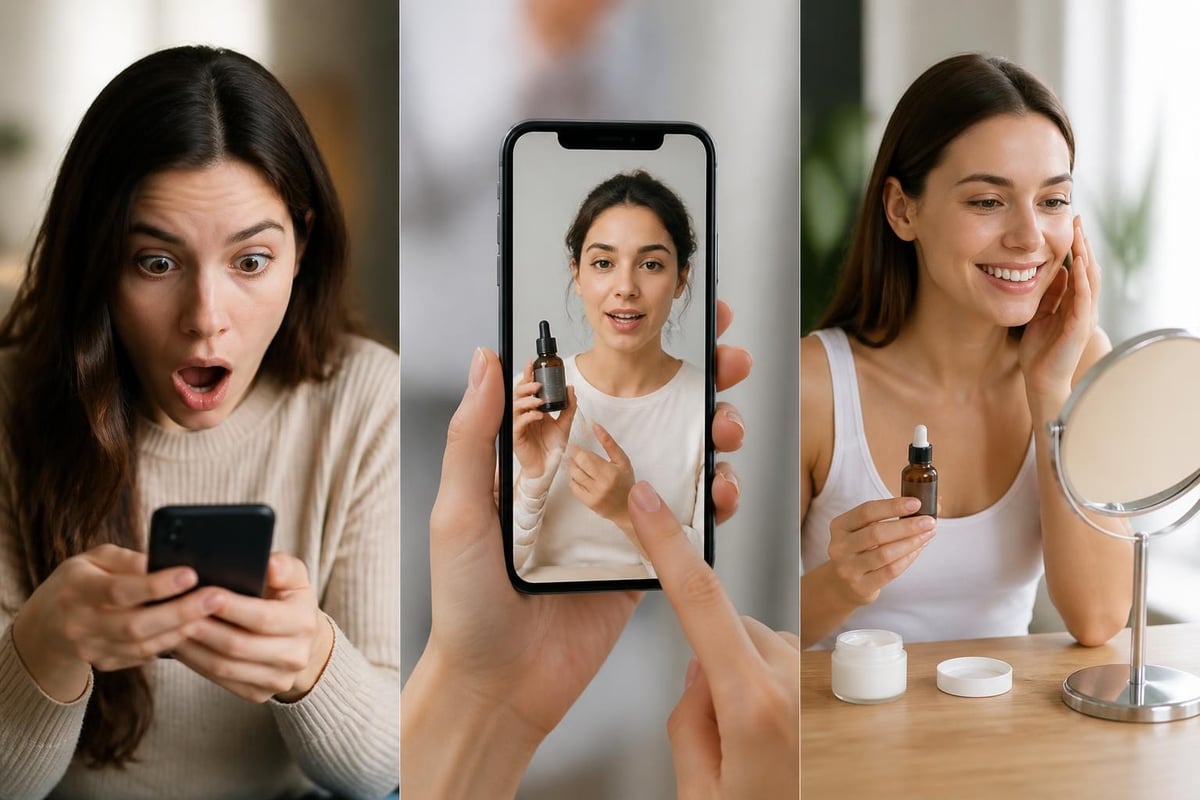
- Close-up of human face showing genuine emotion
- Unexpected visual that breaks pattern expectations
- Product-in-use showing immediate transformation
- Social proof element (numbers, testimonials, ratings)
The opening frame shouldn't try to tell the whole story. Its singular job is to buy you three more seconds of attention. This narrow focus separates high-performing hook ads from mediocre ones.
Audio and Verbal Hook Design
Sound plays a critical role in hook ads, particularly on platforms where users browse with audio enabled. Verbal hooks in the first three seconds should be conversational, benefit-focused, and aligned with the visual message.
| Hook Type | Example Opening | Use Case |
|---|---|---|
| Question | "Want to know the #1 mistake..." | Educational content, how-to |
| Declaration | "This changed everything for me..." | Testimonial, transformation |
| Pattern Interrupt | "Stop! Before you scroll..." | Direct response, urgency |
| Curiosity Gap | "Nobody talks about this..." | Contrarian takes, secrets |
Effective verbal hooks avoid corporate language and marketing jargon. They sound like how real people speak, which is why user-generated content (UGC) style creative consistently outperforms polished brand content in attention metrics.
Building Hook Ads That Convert Beyond Attention
Capturing attention is only the first objective. Hook ads must transition smoothly from attention capture to message delivery and conversion action. This transition phase-roughly seconds four through fifteen-determines whether initial attention translates to business outcomes.
The Hook-to-Value Bridge
The best hook ads use the seconds immediately after the hook to validate the viewer's decision to stop scrolling. This validation comes through quick payoff of the curiosity or promise created in the opening.
Transition Techniques:
- Immediate proof: Show the result or benefit within five seconds
- Story progression: Continue the narrative thread started in the hook
- Credibility injection: Add social proof or authority signals early
- Visual variety: Change camera angle or scene to maintain engagement
Research from Nielsen on marketing effectiveness shows that creative quality contributes more to sales lift than media spend. Within creative quality, the hook-to-value bridge often determines whether viewers stay long enough to receive the core message.
Creative Testing Frameworks for Hook Optimization
Systematic testing separates consistently successful hook ads from one-off wins. Performance marketers should approach hook development as a testable hypothesis rather than a purely creative exercise.
The VidMob analysis of TikTok hooks provides data-backed recommendations for optimizing the first six seconds through structured testing. Their research identifies specific creative variables-text placement, face presence, audio type-that correlate with higher completion rates.
Hook Testing Matrix:
| Variable | Option A | Option B | Option C |
|---|---|---|---|
| Opening | Question | Statement | Visual reveal |
| Talent | Creator face | Product only | Customer testimonial |
| Text | Bold claim | How-to promise | Number/stat |
| Audio | Trending sound | Voiceover | Music only |
Testing should isolate one variable at a time while maintaining platform best practices for what makes a UGC hook work. This disciplined approach builds a library of proven hook patterns specific to your audience and product category.
Advanced Hook Strategies for Saturated Markets
As hook ads become standard practice, cutting through increasing creative clutter requires more sophisticated approaches. Advanced strategies layer multiple attention triggers while maintaining the authentic, native feel that performs best on social platforms.
Multi-Sensory Hook Design
The most effective hook ads in 2026 engage multiple senses simultaneously. Visual movement, audio patterns, and verbal messaging work together to create compound attention triggers that are harder for viewers to ignore.
Consider how academic research on hooking periods uses multimodal analysis to decode which combinations of visual, audio, and text elements create the strongest hooks. This computational approach reveals that combinations of elements outperform any single element in isolation.
Compound Hook Elements:
- Visual: Fast-paced cuts or unexpected movement
- Audio: Pattern interrupt sounds or recognizable music cues
- Verbal: Direct address or provocative statement
- Text: Numbers, questions, or bold claims
- Emotion: Facial expressions or reactive moments
The key is ensuring these elements reinforce rather than compete with each other. Cluttered hooks with too many competing messages actually reduce effectiveness compared to simpler, focused approaches.
Audience Segmentation and Hook Personalization
Generic hooks miss opportunities to connect with specific audience segments. Personalized hook ads that speak to narrow viewer segments often outperform broad-appeal creative, even when reaching smaller audiences.
Segmentation starts with understanding where your viewer sits in their awareness journey. New audience members need different hooks than warm prospects or existing customers. The problem-solution dynamic that works for cold audiences may feel repetitive to engaged followers.
Platforms like VidBud enable marketers to generate UGC ads at scale with AI-powered creative direction that can adapt hooks for different audience segments without proportional increases in production cost. This scalability transforms hook personalization from a luxury to a standard practice.
Hook Ads in the Context of Full-Funnel Strategy
Hook ads don't exist in isolation. They function as part of broader creative strategies that move viewers through awareness, consideration, and conversion stages. Understanding how hooks fit into full-funnel creative ensures consistent messaging while adapting execution to platform and placement.
Top-of-Funnel Hook Priorities
At the awareness stage, hooks prioritize reach and relevance over conversion. The goal is stopping scrollers who might not know they have the problem your product solves.
Top-Funnel Hook Characteristics:
- Broader appeal and relatability
- Problem identification without heavy product focus
- Entertainment or educational value independent of brand
- Lower friction, softer calls to action
- Pattern interrupts that work for cold audiences
These hooks often feel less like ads and more like organic content. They build brand recall and category association without pushing immediate conversion actions.
Mid and Bottom-Funnel Hook Adaptations
As viewers move down funnel, hook ads should reflect increasing product knowledge and purchase intent. Mid-funnel hooks can reference previous exposures, while bottom-funnel hooks assume problem awareness and focus on differentiation.
| Funnel Stage | Hook Focus | Example Opening |
|---|---|---|
| Awareness | Problem identification | "If you've ever struggled with..." |
| Consideration | Solution introduction | "Here's how we solved..." |
| Conversion | Offer and urgency | "Last chance to get..." |
| Retention | Community and loyalty | "You asked for this feature..." |
This progression requires multiple hook variations aligned to audience segments. The Interactive Advertising Bureau's video advertising guide emphasizes tailoring creative to both platform and audience intent, recognizing that the same viewer requires different hooks at different journey stages.
Measuring Hook Effectiveness Beyond View-Through Rate
Traditional metrics like view-through rate capture only surface-level hook performance. Sophisticated measurement frameworks evaluate hooks across multiple dimensions that connect to business outcomes.
Attention Quality Metrics
Not all attention is equal. A viewer who watches three seconds may scroll immediately after, while another viewer who watches the same duration might remain cognitively engaged. Attention quality metrics attempt to measure engagement depth rather than just duration.
Advanced Hook Metrics:
- Hold rate at 3 seconds: Percentage of viewers who stay beyond the hook
- Engagement velocity: Speed of likes, comments, shares in early seconds
- Sound-on rate: Percentage watching with audio enabled
- Completion by hook type: Which hooks correlate with full video views
- Cost per engaged view: CPM adjusted for quality attention
These metrics require integration between creative asset tagging and platform analytics. When implemented properly, they reveal which hook strategies drive not just initial attention but sustained engagement that leads to conversion.
Attribution Modeling for Hook Variations
Multi-touch attribution becomes particularly important when testing hook variations at scale. Different hooks may influence conversion at different points in the customer journey.
A provocative question hook might excel at initial awareness but struggle with conversion, while a benefit-focused hook converts warm audiences efficiently but fails to expand reach. Attribution modeling reveals these dynamics by connecting creative IDs to conversion paths.
Creating Systematic Hook Development Processes
The most successful advertisers treat hook development as a repeatable process rather than a creative lightning strike. Systematic approaches combine creative intuition with structured frameworks and performance data.
The Hook Brief Framework
Effective hooks start with clear creative briefs that define objectives, constraints, and success metrics before production begins. Hook briefs should specify the target viewer, the primary message, the desired action, and the emotional response you're targeting.
Essential Brief Elements:
- Audience definition: Who specifically are we stopping mid-scroll?
- Core message: What single idea must land in three seconds?
- Desired response: What should viewers think, feel, or do?
- Platform requirements: What native elements must we include?
- Success metrics: How will we measure if this hook works?
This framework ensures creative teams understand the strategic context before developing concepts. It also creates accountability by establishing measurable definitions of success.
Rapid Iteration and Creative Velocity
The half-life of effective hooks continues to shrink as platforms evolve and audiences develop ad literacy. What worked last quarter may feel stale today. This reality demands creative processes optimized for velocity and iteration.
Organizations building AI video creation workflows can test more hook variations in less time compared to traditional production approaches. This velocity advantage compounds over time as teams build libraries of proven patterns and quickly identify emerging trends.
Rapid Testing Workflow:
- Develop 5-10 hook concepts per campaign
- Produce minimal viable versions for initial testing
- Launch with small budget splits across platforms
- Evaluate performance within 48-72 hours
- Scale winners, kill losers, iterate on learnings
- Repeat cycle every 1-2 weeks
This continuous testing approach treats hook development as an ongoing optimization process rather than a one-time creative deliverable.
Industry-Specific Hook Strategies
Different product categories and business models require adapted hook approaches. A DTC skincare brand needs different hooks than a B2B SaaS company or a mobile gaming app.
Direct-to-Consumer Product Hooks
DTC brands often excel with transformation-focused hooks that show before-and-after results or unexpected product applications. The immediacy of e-commerce allows hooks to drive direct conversion rather than multi-touch journeys.
DTC Hook Patterns:
- Unboxing and first-impression reactions
- Problem-agitation-solution in six seconds
- Unexpected use cases or product hacks
- Customer testimonial clips with specific results
- Comparison or competitive callouts
These hooks work because they compress the entire purchase consideration into a single scroll-stopping moment. They assume viewers can and will buy immediately if the value proposition lands clearly.
Service and B2B Hook Considerations
Longer sales cycles and higher consideration requirements change hook priorities for service businesses and B2B companies. These hooks prioritize credibility and specificity over entertainment and impulse.
Educational hooks that promise specific insights, data-driven hooks that lead with surprising statistics, and authority-building hooks featuring expert voices tend to outperform pure entertainment approaches in B2B contexts.
Hook ads represent the most critical creative element in modern video advertising, determining whether your message reaches viewers or disappears into the scroll. By understanding the psychological principles behind attention capture, implementing platform-specific best practices, and building systematic testing processes, marketers can consistently create hooks that stop scrollers and drive measurable business outcomes. VidBud helps creators, brands, and marketers generate scroll-stopping UGC ads with AI-powered creative direction designed specifically for the hook-first demands of TikTok, Meta, and modern social advertising-turning strategic briefs into tested, on-brand video creative at the velocity today's platforms demand.