
September 7, 2026
Gen AI Revolutionizing Ad Creative and Marketing
Gen AI is transforming how brands create ad content. Discover how generative AI powers UGC ads, video creative, and marketing workflows in 2026.

The advertising industry stands at a pivotal crossroads in 2026, with gen ai fundamentally reshaping how brands conceptualize, produce, and distribute creative content. Generative artificial intelligence has moved beyond experimental technology to become a mission-critical tool for marketers, creators, and performance-driven brands. This transformation affects everything from ideation and copywriting to video production and personalization at scale. For businesses managing multiple campaigns across platforms like TikTok, Meta, and YouTube, gen ai represents both an opportunity to achieve unprecedented efficiency and a challenge to maintain authentic brand voice while leveraging automation.
Understanding Gen AI and Its Core Capabilities
Gen ai refers to artificial intelligence systems designed to create new content rather than simply analyze or classify existing data. These systems learn patterns from vast training datasets and generate novel outputs including text, images, audio, video, and code.
The Technology Behind Generative Systems
At the foundation of gen ai lie several key technologies. Large language models (LLMs) process and generate human-like text, while diffusion models create images from text descriptions. Generative adversarial networks (GANs) pit two neural networks against each other to produce increasingly realistic outputs, and transformer architectures enable models to understand context across long sequences of data.
The technical landscape of generative AI continues to evolve rapidly. In 2026, multimodal models that simultaneously understand and generate multiple content types represent the cutting edge. These systems can take a text brief and produce coordinated video, voiceover, background music, and supplementary graphics in a single workflow.
Key capabilities that define modern gen ai systems include:
- Content generation across text, image, video, and audio formats
- Style transfer and brand consistency maintenance
- Real-time personalization based on audience segments
- Iterative refinement through conversational interfaces
- Integration with existing marketing technology stacks

Distinguishing Gen AI from Traditional AI
Traditional AI excels at pattern recognition, classification, and prediction. Gen ai takes the next step by synthesizing entirely new content that didn't exist in its training data. This distinction matters enormously for creative applications.
A traditional AI might analyze thousands of successful UGC ads to identify common elements. Gen ai uses those insights to actually create new ads with similar success patterns but unique execution. The shift from analysis to creation unlocks new workflows where human creativity focuses on strategy and refinement rather than production mechanics.
Gen AI Applications in Advertising and Marketing
The advertising industry has embraced gen ai more rapidly than almost any other sector. According to data from the Stanford AI Index 2024, marketing and creative applications represent one of the fastest-growing segments of AI adoption.
User-Generated Content at Scale
User-generated content has become the gold standard for social advertising, particularly on platforms favored by younger demographics. Authentic, relatable videos consistently outperform polished studio productions. The challenge lies in production capacity and cost.
Gen ai solves this bottleneck by enabling brands to create UGC-style content without coordinating shoots, hiring talent, or managing complex production timelines. AI-powered platforms can generate scripts based on market research, create realistic avatars that deliver those scripts naturally, and produce dozens of creative variations in the time traditional production would take for a single asset.
For performance marketers running continuous testing programs, this capability transforms economics. The cost per creative test drops dramatically, enabling more aggressive experimentation and faster iteration cycles.
| Traditional UGC Production | Gen AI UGC Production |
|---|---|
| 1-2 weeks per creative | Minutes to hours per creative |
| $500-$5,000 per video | Fraction of traditional cost |
| Limited variation testing | Unlimited variations |
| Scheduling coordination required | On-demand generation |
| Geographic limitations | Global talent access |
Personalization and Dynamic Creative
Gen ai enables hyper-personalization that was previously cost-prohibitive. Rather than creating a single ad and showing it to millions, brands can generate hundreds or thousands of variants tailored to specific audience segments, geographic markets, or even individual user contexts.
This approach aligns perfectly with platform algorithms that reward relevance and engagement. When users see content that speaks directly to their situation, interests, or pain points, they engage at higher rates. Those engagement signals feed back into platform delivery systems, creating a virtuous cycle of improved performance.
Common personalization dimensions include:
- Geographic location and local references
- Demographic characteristics and life stage
- Previous interaction history with the brand
- Current events and seasonal context
- Platform-specific format optimization
Creative Testing and Iteration
The scientific method applied to advertising requires large sample sizes and controlled variables. Gen ai makes truly rigorous creative testing feasible for brands of all sizes.
Marketers can isolate specific creative elements (hook, offer, visual style, music choice, call-to-action) and generate systematic variations. This testing reveals which elements drive performance and which underperform. Those insights feed into the next generation of creative, creating a continuous improvement loop.
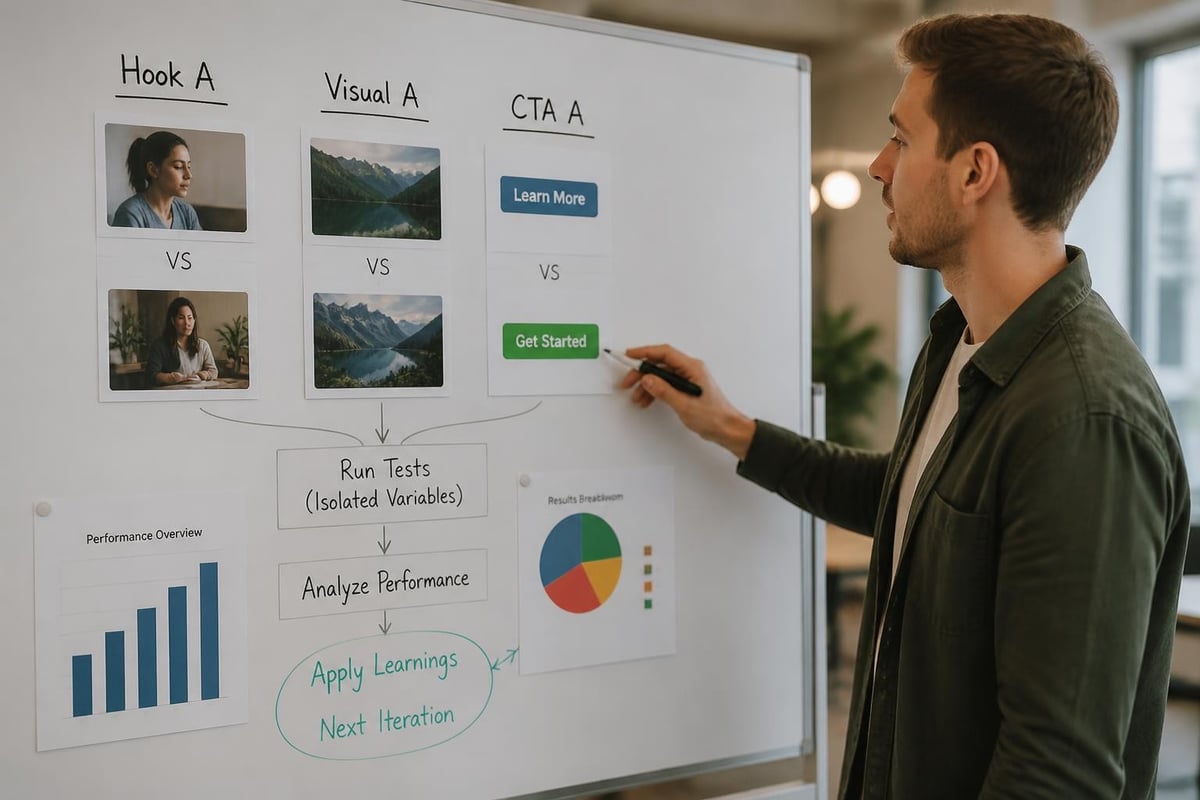
Platforms like VidBud have integrated AI-powered market research directly into the creative workflow, ensuring that every generated ad incorporates insights about what resonates with target audiences. This marriage of data intelligence and creative execution represents the maturation of gen ai from novelty to strategic asset.

Strategic Implementation for Brands and Creators
Successful gen ai adoption requires more than access to technology. It demands thoughtful integration into existing workflows, clear governance frameworks, and alignment between human expertise and machine capabilities.
Building Effective Prompts and Briefs
Gen ai systems respond to the quality of their inputs. Vague, generic prompts produce vague, generic outputs. Detailed briefs that specify audience, objective, tone, key messages, and constraints yield significantly better results.
The best practices for gen ai briefs mirror traditional creative briefs with some additions. Include information about brand voice, competitive positioning, performance benchmarks from previous campaigns, and specific platform requirements. The more context you provide, the more aligned the output.
Essential elements of effective gen ai briefs:
- Target audience description with psychographic details
- Primary campaign objective and success metrics
- Brand voice guidelines and tone examples
- Key messages and mandatory inclusions
- Platform specifications and format requirements
- Competitive context and differentiation points
Maintaining Brand Consistency
One legitimate concern about gen ai adoption centers on brand dilution. If anyone can generate unlimited creative variations, how do brands maintain the consistency that builds recognition and trust?
The answer lies in systematic governance. Leading brands establish clear guidelines that constrain gen ai outputs within acceptable boundaries. These include approved color palettes, logo usage rules, messaging frameworks, and tone-of-voice specifications. Modern gen ai platforms can ingest these guidelines and ensure all outputs comply.
Regular audits of AI-generated content help identify drift before it becomes problematic. Human review remains essential, particularly for brand-building campaigns where consistency matters more than in direct-response testing environments.
Workflow Integration and Team Roles
Gen ai doesn't eliminate the need for human creativity. It shifts creative professionals toward higher-value activities. Strategists focus more on audience insight and positioning. Art directors curate and refine rather than execute from scratch. Copywriters architect messaging frameworks rather than writing every variant.
This transition requires intentional change management. Teams need training on prompt engineering, output evaluation, and strategic thinking in an AI-augmented environment. The marketers who thrive combine traditional creative instincts with technical literacy about what AI can and cannot do.
| Traditional Role | Evolved Role with Gen AI |
|---|---|
| Copywriter writes every ad variant | Copywriter creates messaging frameworks and refines AI outputs |
| Designer creates each visual asset | Designer establishes visual systems and curates AI-generated options |
| Video editor cuts every frame | Video editor directs AI generation and handles final polish |
| Media buyer tests limited creatives | Media buyer tests extensive AI-generated variations |
Challenges and Considerations
Gen ai offers tremendous capabilities, but thoughtful implementation requires acknowledging limitations and addressing legitimate concerns.
Quality Control and Creative Direction
AI-generated content varies in quality. Even the best systems produce occasional outputs that miss the mark tonally, factually, or aesthetically. Automated quality checks can catch some issues, but human judgment remains indispensable.
Establishing clear review workflows prevents substandard content from reaching audiences. Multi-stage review that separates technical compliance checks from creative evaluation ensures nothing slips through. For high-stakes campaigns, human-in-the-loop review at every stage provides appropriate oversight.
Ethical and Regulatory Considerations
The rapid advancement of gen ai has outpaced regulatory frameworks in many jurisdictions. Brands must navigate questions about disclosure, intellectual property, data privacy, and potential biases in AI systems.
Best practices include transparent disclosure when content is AI-generated (particularly for synthetic humans or voices), rigorous testing for demographic bias in outputs, and adherence to emerging standards. The NIST AI Risk Management Framework provides structured guidance for organizations building trustworthy AI systems.
Research on generative AI misuse highlights potential harms including deepfakes, misinformation, and fraud. While these concerns primarily affect synthetic identity rather than advertising applications, responsible brands should implement safeguards against unintended harmful uses.
Cost-Benefit Analysis
While gen ai dramatically reduces per-unit creative costs, implementing these systems requires investment in technology, training, and process redesign. Smaller organizations should assess whether their creative volume justifies adoption or whether traditional methods remain more economical.
The calculus shifts as platforms mature and pricing becomes more accessible. In 2026, cloud-based gen ai tools operate on subscription models that make advanced capabilities available to businesses of all sizes. The question becomes less about affordability and more about strategic fit.
Future Trajectories and Emerging Capabilities
The gen ai landscape continues to evolve at remarkable speed. Understanding emerging trends helps organizations prepare for the next wave of capabilities.
Multimodal Integration and Reasoning
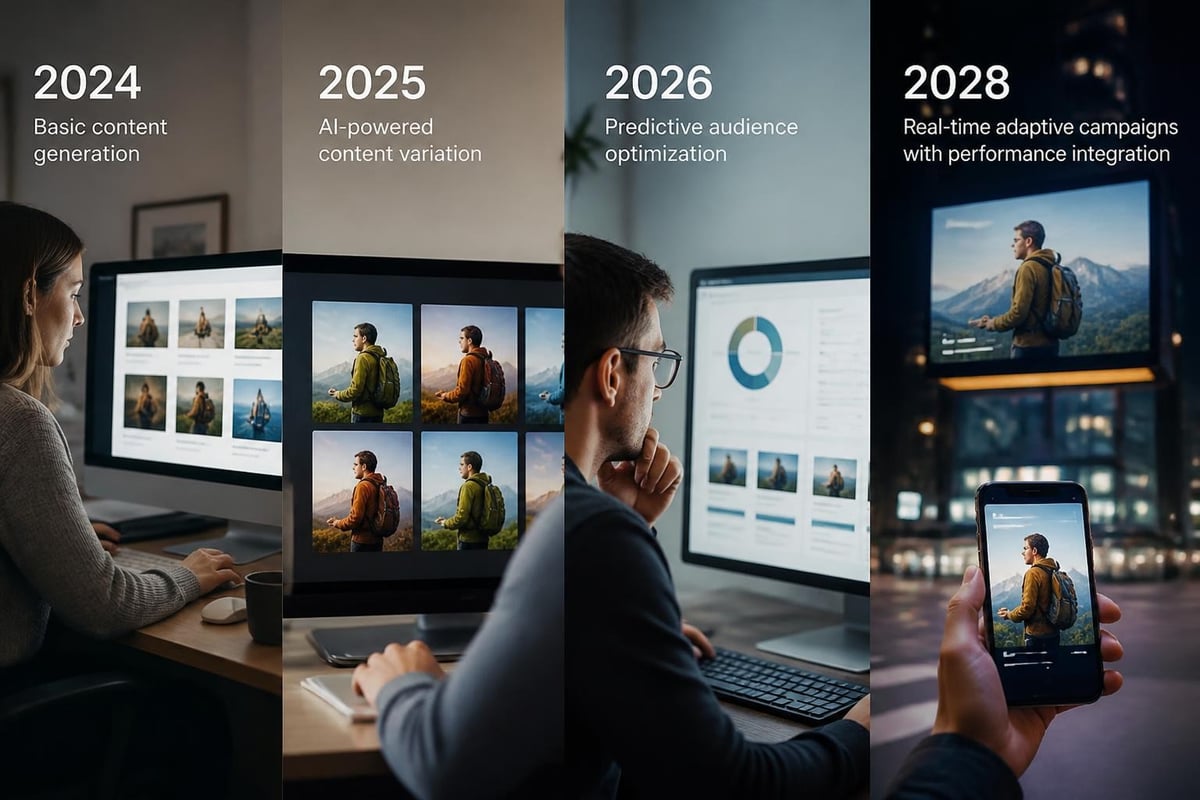
Current gen ai systems excel at specific tasks. Next-generation platforms will integrate multiple modalities more seamlessly and demonstrate stronger reasoning capabilities. An AI creative director might analyze campaign performance data, identify opportunities, generate test hypotheses, create corresponding creative variations, and recommend optimization strategies in a single workflow.
According to recent academic research, key technical challenges include improving controllability, reducing computational requirements, and enhancing evaluation frameworks. Progress on these fronts will expand what's possible in production environments.
Real-Time Adaptation and Continuous Learning
Future gen ai systems will adapt in real-time based on performance signals. Rather than generating static creative assets, these platforms will continuously evolve ads based on engagement data, platform algorithm changes, and competitive dynamics.
Imagine a campaign where the AI monitors performance across hundreds of variants, automatically retires underperformers, generates new candidates informed by what's working, and optimizes budget allocation-all without human intervention beyond strategic oversight. This level of automation is technically feasible today and will become increasingly common.
Anticipated developments in gen ai for advertising:
- Improved photorealism and elimination of uncanny valley effects
- Better emotional intelligence and nuanced tone matching
- Seamless integration across the entire marketing technology stack
- Enhanced localization and cultural adaptation capabilities
- Predictive performance modeling before content reaches audiences
Democratization and Accessibility
As gen ai tools become more sophisticated, they simultaneously become more accessible. This democratization enables smaller brands and individual creators to compete with larger organizations on creative quality. The competitive advantage shifts from production resources to strategic insight and brand positioning.
For the creator economy, this trend is particularly significant. Independent creators can produce professional-grade content without studio access or production teams. This capability expands creative entrepreneurship and enables more diverse voices in commercial content.
Platform-Specific Optimization
Different advertising platforms have distinct requirements, audience expectations, and algorithmic preferences. Effective gen ai implementation accounts for these platform-specific nuances.
TikTok and Short-Form Video
TikTok's algorithm rewards content that captures attention immediately and maintains engagement throughout. Gen ai tools optimized for TikTok emphasize strong hooks in the first second, trend integration, and authentic-feeling presentation even when synthetically generated.
The platform's younger demographic particularly values creativity and authenticity over production polish. Gen ai that emulates successful UGC patterns performs well, while content that looks overly corporate or scripted struggles regardless of production quality.
Meta Ecosystem
Facebook and Instagram present different challenges. The Meta platforms serve diverse demographics and support multiple content formats from Stories to Reels to in-feed posts. Gen ai needs to optimize for each format's requirements while maintaining brand consistency.
Meta's advertising system also provides rich performance data that can inform gen ai inputs. Brands can feed engagement metrics, conversion data, and audience insights back into creative generation workflows, creating a closed-loop optimization system.
Cross-Platform Strategy
The most sophisticated gen ai implementations generate platform-optimized variations from a single creative concept. A core message might manifest as a 60-second TikTok video with trending audio, a 15-second Instagram Story with interactive elements, and a carousel post for Facebook feed-all generated from one brief but tailored to each platform's strengths.
This approach maintains message consistency while respecting platform differences. It also dramatically improves workflow efficiency compared to treating each platform as a separate project.
Measuring Success and ROI
Implementing gen ai for advertising requires clear metrics to evaluate effectiveness and justify continued investment.
Performance Metrics
Standard advertising metrics apply to AI-generated content: click-through rate, conversion rate, cost per acquisition, and return on ad spend. The additional dimension involves comparing AI-generated creative against human-produced benchmarks.
Leading organizations track creative velocity (assets produced per time period), cost per creative unit, test throughput, and win rate (percentage of AI-generated creatives that meet performance thresholds). These metrics quantify the operational benefits separate from campaign performance.
Attribution and Learning
Gen ai's value extends beyond individual campaign performance to the organizational learning it enables. By testing more creative variations more quickly, brands discover insights about audience preferences, message resonance, and creative elements that drive performance.
Capturing and institutionalizing these insights ensures the value compounds over time. Teams become smarter about what works, and that intelligence feeds into both AI-generated and human-created content.
Key success indicators for gen ai advertising programs:
- Increased creative testing velocity
- Reduced cost per creative asset
- Improved campaign performance metrics versus historical benchmarks
- Shortened time from concept to market
- Enhanced team satisfaction and strategic focus
- Documented insights about audience preferences and creative effectiveness
Skills and Competencies for the Gen AI Era
Marketing professionals navigating the gen ai transformation need to develop new competencies while maintaining traditional creative judgment.
Technical Literacy
Understanding gen ai's capabilities and limitations enables better strategic decisions. Marketers don't need to become machine learning engineers, but basic familiarity with how these systems work, what they do well, and where they struggle improves outcomes.
This includes prompt engineering skills, understanding of different AI model types, and awareness of quality indicators that distinguish strong outputs from weak ones. Teams can explore these capabilities through platforms like the VidBud blog, which offers insights into AI-powered advertising workflows.
Strategic Thinking
As AI handles more tactical execution, human value concentrates in strategic domains. Understanding audience psychology, competitive positioning, brand building, and cultural context becomes more important, not less. These distinctly human capabilities guide AI systems toward meaningful objectives rather than optimizing toward shallow metrics.
Ethical Judgment
Deciding when AI use is appropriate, how to disclose it, and what safeguards to implement requires ethical judgment that algorithms cannot provide. Marketing leaders must establish guidelines that protect consumers, maintain trust, and align with organizational values even as technology enables new possibilities.
Gen ai has fundamentally transformed advertising and marketing in 2026, enabling unprecedented creative velocity, personalization, and testing sophistication. The brands and creators who successfully harness these capabilities maintain strategic oversight while leveraging AI for execution, combine data intelligence with creative intuition, and treat gen ai as an augmentation of human creativity rather than a replacement. VidBud enables this transformation by turning creative briefs into scroll-stopping UGC ads through AI-powered market research, creative direction, and video generation, helping brands and marketers scale their ad creative production while maintaining the authenticity and performance that drive results on TikTok, Meta, and beyond.